
Operation Epic Fury is about stopping Iran from developing long-range missiles and a nuclear weapons program, but there is a second purpose… oil. To pretend this is not an undertone is simply foolish because that is just as important as stopping the nuclear program. We cannot allow a terrorist nation to have the ability to choke off more than 20% of the global oil supply on a whim.
Donald Trump has been talking about negotiations with Iran for weeks, something the other side has denied, which we can now see is clearly a lie. An offer was put on the table, and it showed progress, but President Trump said it was not enough. And he is right.
The only detail we need to see to know the deal is unacceptable is that Iran wants to continue to control the Strait of Hormuz, which we simply cannot allow to happen, as it risks the global economy collapsing at the hands of a terrorist nation.
On Easter Sunday, Trump put Iran on the clock, giving the nation until Tuesday to come to the table with a real offer or face the wrath of our military machine. Trump had posted his threat to Iran on Truth Social, telling Iran to “Open the F***in Strait,” as well as noting that “Tuesday will be Power Plant Day, and Bridge Day.”
Trump gave Iran until 8:00 p.m. Eastern on Tuesday as a deadline, and added that if Iran failed to comply, it would be “living in hell.”
Democrats, who have been dropping F-bombs left and right for years, then claimed that we needed to activate the 25th Amendment to remove Trump from office because he was unhinged. The hypocrisy, my friends, runs deep.
Iran made its own threats, with Iranian military spokesman Ebrahim Zolfaghari, according to the New York Times, responding:
“If attacks on civilian targets are repeated, the subsequent phases of our offensive and retaliatory operations will be carried out much more crushingly and extensively.”
On Monday, President Trump revealed that a proposal had been made by Iran, reported Fox News. And while it was a “significant proposal,” it was not good enough. Trump stated:
"They made a proposal, and it's a significant proposal, a significant step. It's not good enough, but it's a very significant step. They are negotiating now. And they have made a very significant step. We'll see what happens."
Trump was referring to a reported 10-point plan sent by Iran to Pakistan, but the suggested proposal called for a permanent end to the war rather than a 45-day ceasefire, which had reportedly been a suggested condition.
The proposal, according to a CNN report, called for, among other things, “a protocol for safe passage through the Strait of Hormuz, reconstruction, and the lifting of sanctions."
One US official who saw the proposal described it as “maximalist,” which does not bode well if Trump expects Iran to be willing to negotiate a deal in good faith.
Israeli Prime Minister Benjamin Netanyahu has expressed concerns about any deal that would result in a temporary ceasefire, and Trump does not appear to be ready to go down that road either. He told the media:
"We are obliterating their country. And I hate to do it, but we're obliterating and they just don't want to say 'uncle.' They don't want to cry, as the expression goes, 'uncle.' But they will.”
Trump seems unwilling to extend the deadline based on the current situation, so as of Monday evening, Iran has little more than 24 hours to come to terms or face obliteration, per Trump’s own words. To that point, Trump had stated:
"If they don't make a deal, they will have no bridges and no power plants.”
As I noted in my opening, yes, this is about nuclear weapons and long-range missiles, as that is 1a and 1b, but 1c is oil, and we all know it.
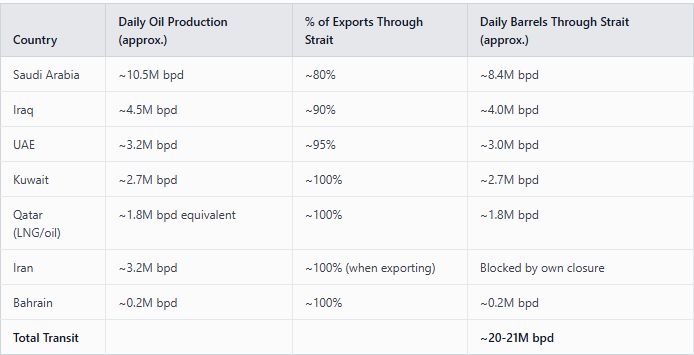
The Strait of Hormuz is about 21 miles wide at its narrowest point, with shipping lanes a mere two miles wide in each direction and runs between Iran and Oman. In essence, it is a choke point for the transportation of more than 20% of the world’s oil supply (more than 17 million barrels a day pass through this waterway).
The Strait connects the Persian Gulf to the Gulf of Oman and the Arabian Sea, and some of the world’s biggest oil-producing nations rely on the Strait to transport their oil.
After Operation Epic Fury was launched, Iran effectively closed down the Strait, more recently passing a bill to formalize a collection of tolls from vessels passing through the Strait.
When Trump was asked if he would accept Iran charging tolls as part of a peace deal, he responded, “What about us charging tolls?”
The table below provides context on just how important the Strait of Hormuz is to the global oil supply:
Threats over the Strait are nothing new, and have been taking place since the 1980s, when Operation Earnest Will (1987) was launched to escort tankers through the Strait, as Iran and Iraq had launched attacks against opposing oil tankers.
In 1988, during the Iran-Iraq War, the USS Vincennes misidentified Iran Air Flight 655 as an F-14 Tomcat, which was part of the Iranian military inventory, and shot the passenger flight down. A total of 290 people were killed in the strike.
More recently, in 2019, Iran seized the Stena Impero, a British tanker.
With repeated threats by Iran to use the Strait of Hormuz as leverage, the US Fifth Fleet is now based in Bahrain as a deterrent and to protect the corridor.
In addition to the Strait of Hormuz, Aliakbar Velayati, a top advisor for the newly installed Supreme Leader, Mojtaba Khamenei, has threatened to target the Bab al-Mandeb Strait, reported Forbes.
This waterway, which connects the Red Sea to the Suez Canal, would likely be targeted by proxy fighters for Iran, the Houthis, who entered the conflict last week.
Roughly 10% of all global trade uses this waterway, with the new regime stating that it "views Bab al-Mandab with the same intensity as Hormuz."
We have all seen the impact here in the United States on oil prices since this war started, and we are far from alone in this conundrum.
Panic buying spurred shortages in many countries, forcing governments to release reserves as well as take other measures to offset their oil shortages.
On Sunday, OPEC+ announced that it would increase oil production by 206,000 barrels per day, reported ABC News, but the added production means little if the oil cannot safely pass through the Strait.
In addition to the closure of the Strait, Iran has hit numerous tankers and some production facilities in the Middle East with drone attacks, which also adds to the cost of production. The energy infrastructure in these cases must be repaired, which costs money, and these facilities must be taken down for repairs. This all adds to the financial impact caused by this conflict.
These costs could become significantly higher if Iran follows through with its threats made after Trump’s threats for the Tuesday deadline. Iran has threatened to hit water and energy facilities in the Gulf states if Trump carries out his infrastructure strikes.
Currently, Pakistan, Egypt, and Turkey are coordinating negotiations.
For the United States, Politico reported that Steve Witkoff and Jared Kushner are heading the negotiations, with Vice President JD Vance ready to tap in if Iranian officials get involved directly with the negotiations.
Mojtaba Ferdousi Pour, head of Iran’s diplomatic mission in Cairo, has been adamant that a ceasefire is not acceptable, telling the Associated Press (via The Times of Israel):
“We only accept an end of the war with guarantees that we won’t be attacked again.”
There is no way a ceasefire should even be considered because all that would do is provide a respite for which Iran could gather itself, resupply, and resume hostilities once the ceasefire was over. Not to mention, Trump is on a 60-day clock due to the War Powers Resolution Act, so the only end he can accept is an end to the conflict overall.
As we noted above, the 10-point plan submitted by Iran allows the terrorist nation to keep the Strait under its control, and this is unacceptable. Iran is over a barrel right now, but it is acting as though it has the position of strength. This is the one real chance we have to take control of the Strait away from Iran to remove this leverage permanently, and we need to exploit it.
The Strait must be reopened as part of any deal, period. It removes any leverage Iran has and allows the global oil supply to resume. The fact that Iran has implemented a toll while negotiating shows the nation cannot be trusted to act in good faith. This part of the deal has to be a one-way street.
Netanyahu has also warned against any ceasefire deal, and for good reason. He knows if Iran can continue its nuclear program and/or maintain control of the Strait, this is all for naught in terms of serving US and Israeli interests.
The fact that Iran has threatened to shut down Bab al-Mandeb is yet more proof that the nation cannot be trusted to act in good faith. Terror is all Iran knows, using threats such as this as its currency. It’s time we shatter that piggy bank so it can never be put back together.
Yes, there is some economic pain right now, but that is to be expected. Democrats are using this as a talking point because they are more interested in scoring political points and taking down Donald Trump at all costs than they are in defending this nation (and the world, for that matter) against a legitimate terror threat.
We have an opportunity to remove one of the biggest threats to the global economy, as well as one of the biggest terror threats in the world. Trump has Iran in the vice grips, far worse than he did when he had the nation nearly bankrupt during his first term with sanctions. Joe Biden released the pressure then, and Trump cannot make the same mistake here.
Iran can talk as tough as it wants to, but Trump holds the leverage. Iran has two choices: submit and live, or be a braggart and be obliterated. Economic stability. A real chance for peace in the Middle East and a major terror threat eliminated. Yes, to me, that is worth paying a few dollars more at the pump for a few months.
